A conversation only the two of you can ever read.
No phone number. No email. Nothing to hand over, because we never collect it. Messages lock on your device and disappear after 24 hours.
Works right in your browser. No install, no app store.
A real conversation, encrypted end-to-end
A private messenger and a public square. The line between them is the point.
Most apps are one or the other. Vault is both, and it never leaves you guessing which one you're in.
Chats nobody can read
One-to-one messages, groups and calls, all end-to-end encrypted. The server moves a locked box it has no key to. Not us, not someone who steals the server, not anyone holding a court order.
- Locked on your device before it's sent
- A new key for every single message
- Calls relayed, so neither side learns the other's IP
Thoughts anyone can read
A public feed on the same 24-hour clock. Say what you actually think to nobody in particular, follow people worth reading, and watch all of it expire by tomorrow.
- Unpopular, offensive and wrong opinions stay up
- No algorithm deciding who deserves an audience
- Nothing accumulates into a permanent record of you
This half is stored where the server can read it — that's what makes it public. The app says so every time you post, because a feed pretending to be encrypted would undermine the half that is.
What "free to speak" means here, exactly
Being rude, wrong, disliked or argumentative isn't a removable offence. Reports on those grounds are closed without action, and we say that out loud rather than running a queue that quietly does nothing.
Content that is illegal: sexual content involving minors, intimate images shared without consent, credible threats of violence, and material promoting terrorism.
Mute hides someone and tells them nothing. Block hides you from each other everywhere. Keyword filters hide whatever you choose — and never leave your device.
You don't have to switch
Keep whatever you already use. Vault runs alongside it, for the conversations that shouldn't live there.
- No phone number to hand over
- No contact list to import
- Nobody to convince to migrate
- Opens in a browser, nothing to install
Three things happen. We're only ever holding a locked box.
No math, no key exchange diagrams, just what actually happens when you hit send.
You write a message
It's locked on your own device, using a key that never leaves it, before it ever touches our servers.
It travels sealed
Our servers move the locked box from one device to the other. We can see it exists, but never what's inside.
Only they can open it
Your friend's device holds the one key that fits. We never had a copy, so we can't hand one over to anyone.
Key exchange: X3DH
Before you've ever messaged someone, your device publishes a bundle of public keys to the server: an identity key, a signed prekey, and a batch of one-time prekeys. When a friend wants to message you, even while you're offline, their device fetches that bundle and runs four Diffie-Hellman exchanges against it (X3DH: Extended Triple Diffie-Hellman) to derive a shared secret neither of you has typed or transmitted anywhere.
Per-message encryption: the Double Ratchet
Every message advances a symmetric-key ratchet, so each one is locked with its own unique key derived from the last. Each time the conversation changes direction, a fresh Diffie-Hellman exchange folds a new secret into that chain. The result: even if a single message key were somehow exposed, it wouldn't unlock any message before or after it.
What actually gets encrypted
Message bodies are sealed with AES-256-GCM using keys derived via HKDF. Your local vault (session state, drafts, cached keys) is protected with Argon2id against your password. All of this runs in your browser via the Web Crypto API, so plaintext and raw key material never leave your device.
Calls: WebRTC over TURN
Voice and video use WebRTC, encrypted end-to-end with DTLS-SRTP over a key negotiated through your Double Ratchet session. Media is routed through our TURN relay rather than connecting peer-to-peer, which means neither side ever learns the other's IP address or general location. The relay only ever sees encrypted packets.
The parts of "private" that are easy to skip.
Swipe to compare →
| Vault | Signal | Telegram | ||
|---|---|---|---|---|
| Asks for your phone number | Never | Required | Required | Required |
| Private by default, no toggle | Yes | Yes | Only in "Secret Chat" | Yes |
| New lock generated per message | Yes | Yes | Secret chats only | Yes |
| Anyone can inspect the code | Yes | Yes | Partial | No |
| Messages expire automatically | Every message, 24h | Opt-in | Opt-in | Opt-in |
Built so there's simply nothing of yours to lose.
Group chats stay private
Every member gets their own lock, so a large group is never a weak point.
Share files without a trace
Photos and files travel straight between devices, encrypted the whole way, never stored in the open.
Calls no one can listen to
Locked with a key only the two of you hold. Calls route through our relay, so the other person never sees your IP address or location.
Unlock with your face or fingerprint
No password to steal or forget. Your device's own lock protects the key.
Add a device with a scan
Point your phone at a QR code to bring a laptop or tablet in. No account transfer, no new password.
Nothing lingers after you close it
Close the tab and your keys are erased, not just hidden, so there's nothing left to recover.
A public square, on the same clock
Post something anyone on Vault can read, reply to and follow. It's the one part of Vault the server can see — and it says so — and like everything else, it's gone in 24 hours.
The actual app, on your desktop and in your pocket.
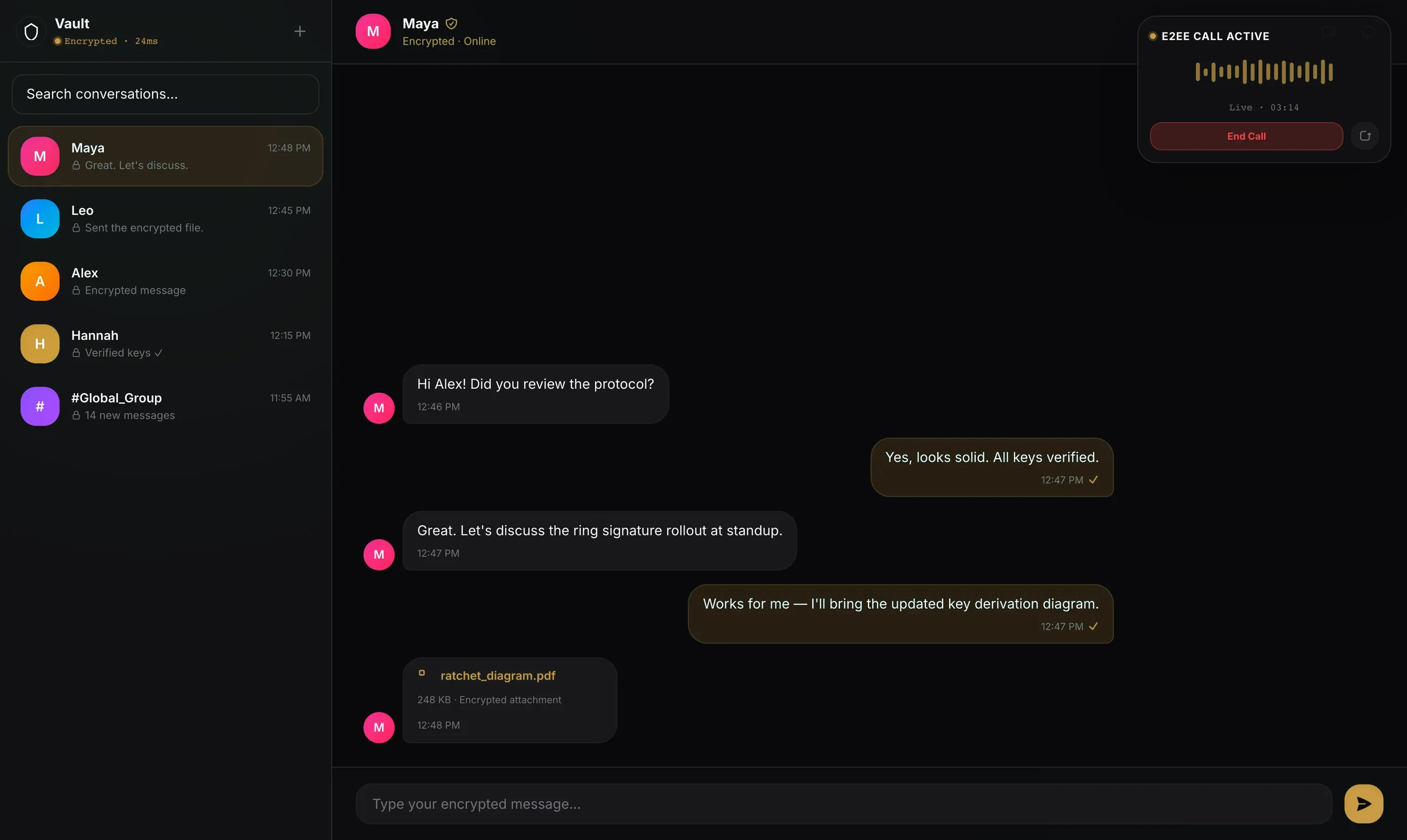
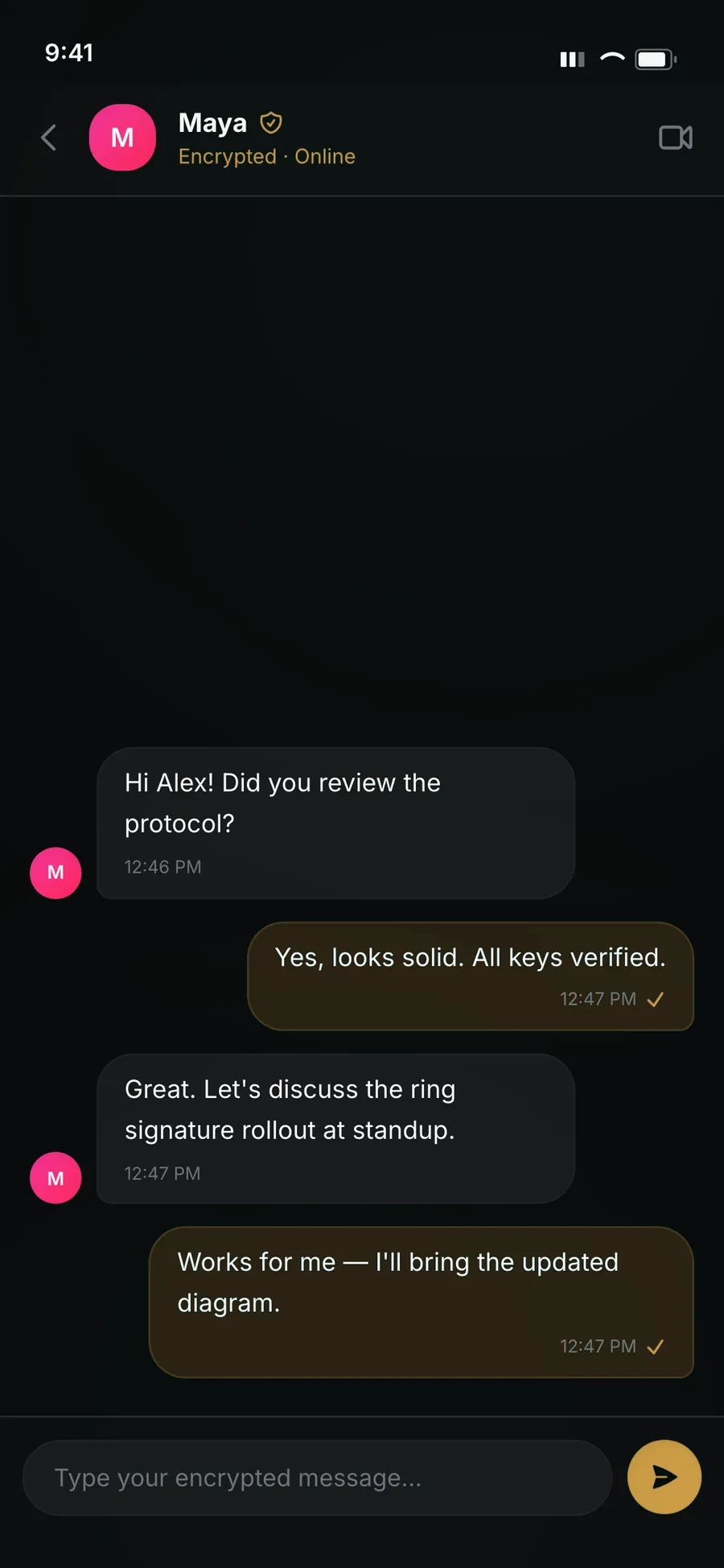
The web app needs nothing installed — the Android app is there if you want it.
Not on the Play Store yet (official listing is in review). A single signed APK, built directly by the Vault developer.
Direct APK
Signed and built by the Vault developer. The app checks for new versions itself and prompts you when one's available.
Download APK →Automatic updates
Add this repository in F-Droid, Droid-ify or any compatible client and updates arrive the same way as any other app.
https://vaultapp.space/fdroid/repo Not the official f-droid.org listing — this is Vault's own repository, so releases arrive without waiting on review.
Whatever level of detail you want.
Can anyone at Vault read my messages?
No. Your messages are locked on your device with a key we never receive. Even if someone asked us to hand over a conversation, we'd have nothing readable to give them.
What happens if I lose my password?
Your key lives on your device, protected by your password. We don't keep a backup copy on our servers, on purpose. If you lose both, that conversation history can't be recovered. You can opt into an encrypted backup ahead of time if you want a safety net.
Is Vault really free?
Yes. Vault is free to use, and the code is open for anyone to inspect.
What if Vault's servers go down?
New messages can't send until they're back, but nothing already delivered to your device is affected, and nothing is exposed while it's down.
What key exchange protocol does Vault use?
Sessions are bootstrapped with X3DH (Extended Triple Diffie-Hellman) against pre-published identity, signed prekey, and one-time prekey bundles, allowing asynchronous session establishment with an offline recipient.
How is forward secrecy maintained?
Post-handshake messaging uses the Double Ratchet: a per-message symmetric-key ratchet combined with a Diffie-Hellman ratchet on each direction change, so compromise of one message key doesn't expose past or future messages.
Is Vault open source?
Yes — licensed AGPL-3.0-or-later, with the full client and server source public on GitHub.
Can I self-host Vault?
Not yet. Vault currently runs on centralized infrastructure with no peer-to-peer fallback. Self-hosting is on the roadmap.
Not answered here?
Say it once. Then let it disappear.
No number, no email, no history left behind, just a private conversation.